
Over the past several months, members of our Eden Hall Farm Team have collaborated with Madison McLean of the Library Seed Farm to engage the public in a series of seed keeping workshops and promote the sharing of seed keeping knowledge among members of the urban farming community in Pittsburgh.
This series was born from pre-existing partnerships between McLean and local urban agriculturist Ebony Lunsford-Evans, better known as Farmer Girl Eb within the community. When Evans approached McLean to inquire about increasing the efficiency and accessibility of seed keeping practices on her own land, they recognized a need within the region to encourage the sharing of seed keeping knowledge and teaching of best practices to curious agriculturalists, students, and community members.
Because these initial discussions around seed processing best practices emerged from troubles with Collard Green seeds, a crop Eden Hall Farm has long since been interested in, Bernard Sekey (MAFS ‘25) reached out to Drs. Laura Livingston and Chris Murakami of the Eden Hall Farm Sustainable Agriculture Leadership Team to ask about how the questions being circulated among members of the Pittsburgh urban farming community could be used to open doors for the creation of a local knowledge-sharing network.
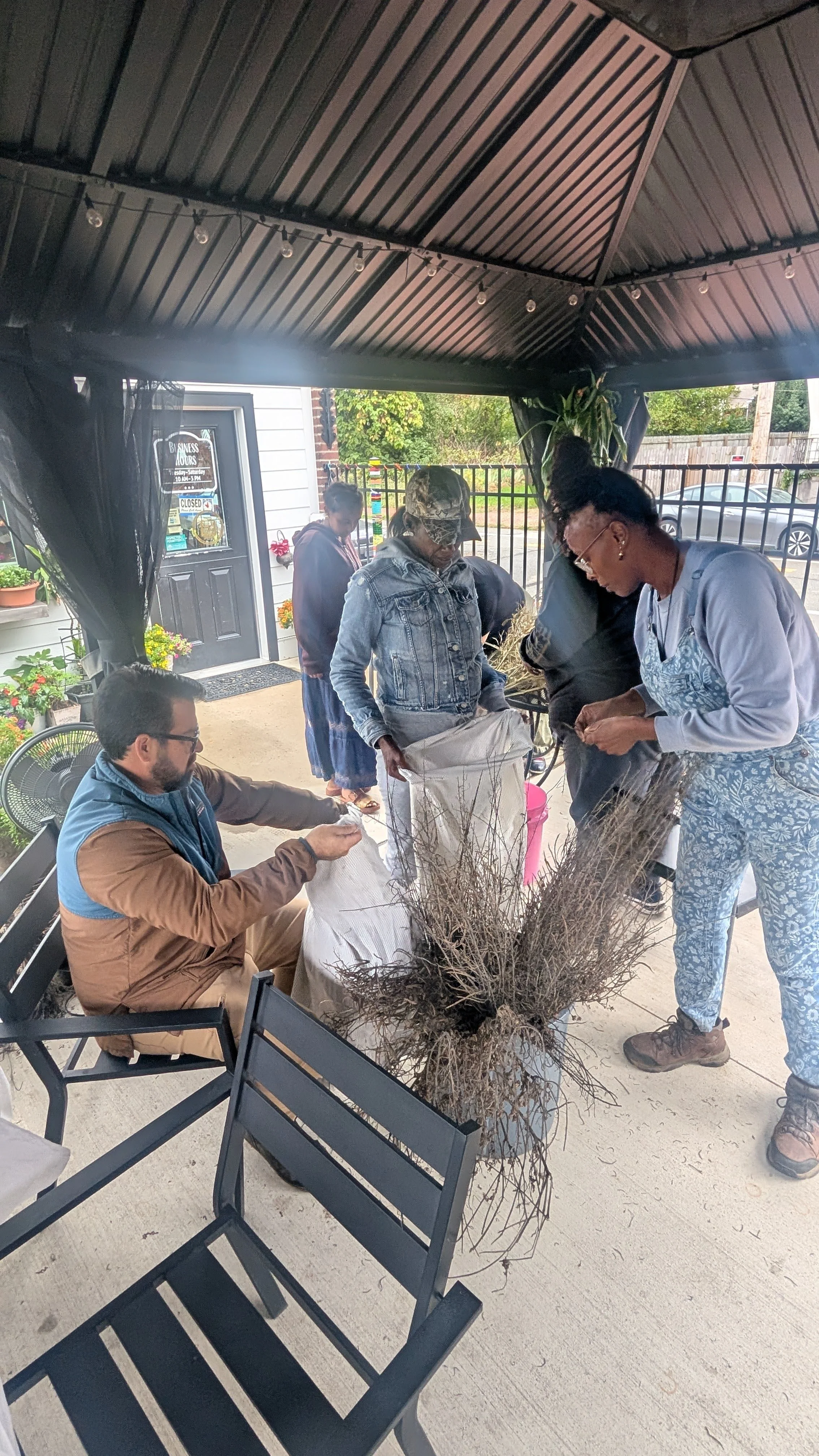
Event participants learn to tresh seeds
Photo courtesy of Dr. Laura Livingston
The concept of a workshop series, hosted in partnership with Eden Hall Farm, soon emerged. In an email interview on the topic, McLean shared with me her joy in saying “I was excited about this, as I would be teaching not only seed keeping practices, which I love to do, but hopefully helping develop systems for my fellow growers that are more efficient.” When searching for venues to host these events, Lisa Freeman expressed her interest in having the series take place at the Freeman Family Farm Store (“she was so on board!”, said McLean), and so the planning and execution began.
To prepare for the workshops and help make informational concepts in seed keeping more accessible and understandable, McLean began creating mini-zines to share at the workshops and collecting a small inventory of tools she could share with participants. Combining these two preparation methods, McLean said “I knew I was going to feature a tool called a bucket thresher, that is really helpful in threshing large quantities of seed (especially brassicas [i.e., collard greens]) because it's a cheap tool to build and pretty accessible. So I decided to write and publish a zine on how to make one and bring it with me to share so that they can build one and employ it if they felt that it was a good fit for them.”
During the workshops, instructors shared a variety of seed keeping methods, ranging from low- to high-tech and at differing levels of commitment and cost. These methods included:
Using mesh, pop-up laundry bins to harvest and dry shattering seeds
Manually threshing seeds by putting stalks into pillow cases and crushing them out with a rolling pin
Manually threshing by hitting stalks on the side of a bucket (bucket threshing)
Utilizing seed aspirators
For each of the methods presented, McLean led a short demonstration and then allowed for participants to practice as well. Additionally, facilitators guided discussions on topics such as winnowing and viable versus inviable seeds to create an open dialogue surrounding common topics within seed keeping discussions.
According to McLean, workshops like these are important to the development of regional agricultural systems and “bringing non-members into the fold” while still providing space for current agriculturalists to share updates on their farms, distribute resources, and discuss ideas. Bringing all of this together, McLean said “not only do these workshops help spread information and give folks a chance to learn something hands-on, but the coming together aspect is a huge deal. Even though we are all physically closer together than a lot of rural agriculture, urban agriculture really lends itself to niches and it's hard to get outside of that niche.”
Our off-campus work with McLean directly connects to the deepening and expansion of our own seed keeping practices on Eden Hall Farm. This fall, our farm team has engaged in the selecting and saving of Aji Dulce Pepper, Rittle Beans, Bloody Butcher Corn, Tomato, and Okra seeds - in addition to the Collards mentioned above.
We look forward to the continuation of our community partnerships with local experts such as Madison and Ebony, and facilitating the sharing of seed keeping knowledge on campus and beyond.